

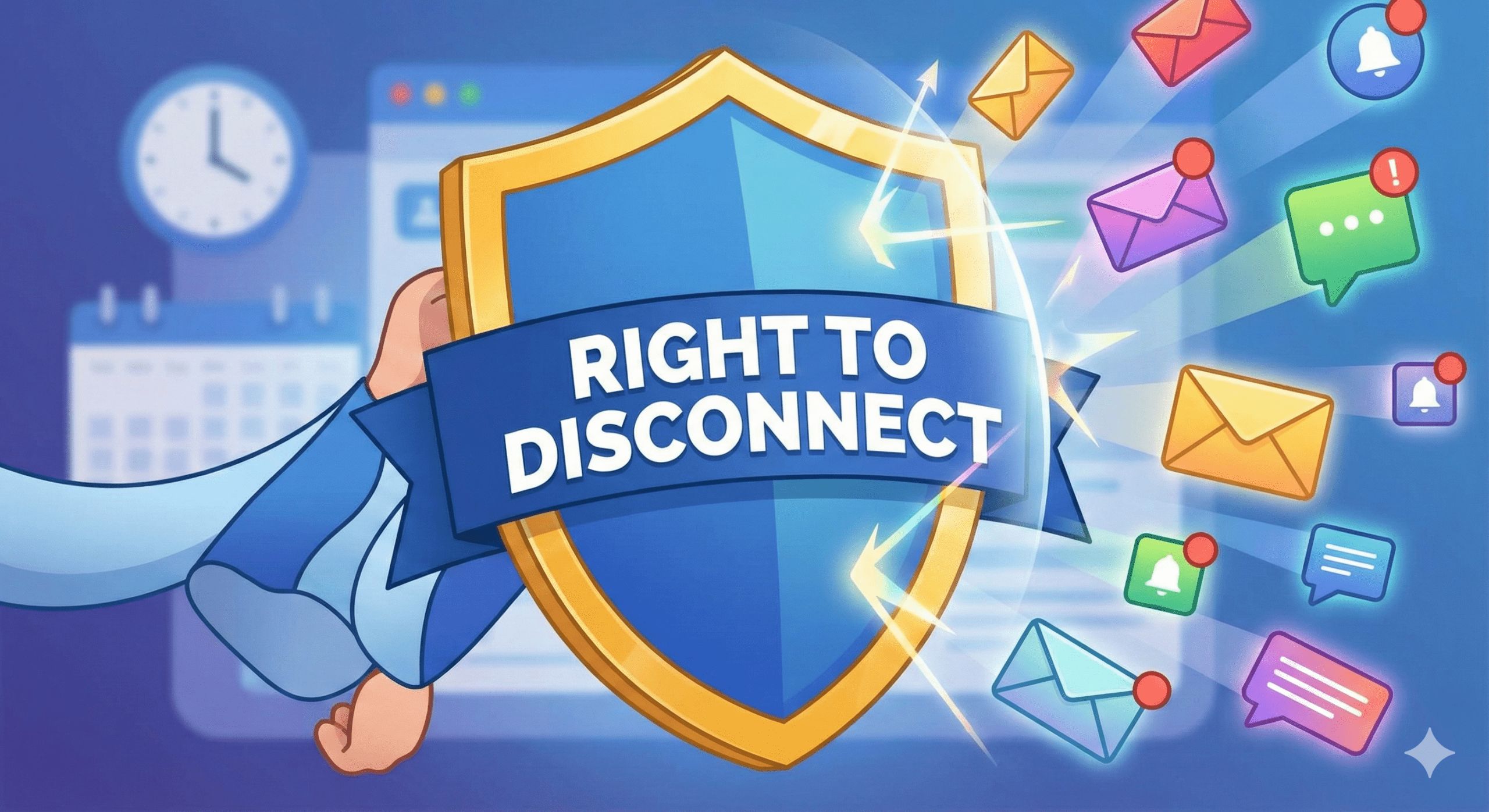
Right to Disconnect Bill is a landmark proposal that gives employees the legal right to ignore work calls, emails and messages after office hours and on holidays, without fear of punishment. It aims to protect mental health, reduce burnout and push companies toward a healthier, “Human-First” Work Culture.
In a world where smartphones, emails, and work-chats follow us home, the boundary between office hours and personal time has almost vanished. The “always-on” culture, fuelled by digital connectivity and remote work, has turned many evenings into unpaid shifts — a trend linked with burnout, stress, and deteriorating work–life balance. The newly introduced Right to Disconnect Bill, 2025 offers a potential remedy: a legal shield for employees to switch off after work, reclaim their time and mental peace.
“A nation cannot build a sustainable economy on a workforce that is exhausted, anxious and permanently on call.”
—
What you’ll learn
- What is the Right to Disconnect Bill, 2025?
- Why is this Bill Important — Especially in Today’s Digital Age
- What the Bill Promises — Key Provisions & Rights
- How Other Countries Are Doing It — A Global Perspective
- What It Could Change — For Employees and Work Culture in India
- Challenges & Concerns — What’s Not a Done Deal
- Why This Should Matter to You
🧑⚖️ What is the Right to Disconnect Bill, 2025?
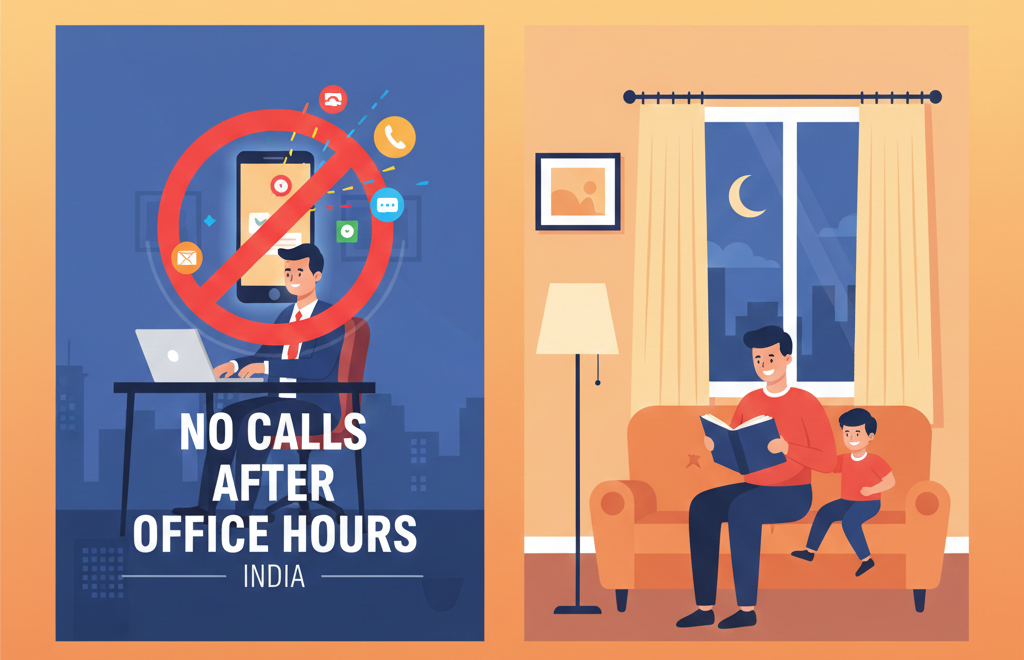
At its core, The Right to Disconnect Bill gives every employee the legal right to refuse work-related communication – Calls, emails, messages, video meetings – after official working hours and on holidays. It means that not responding after hours cannot be treated as misconduct or grounds for poor appraisal, harrasment or dismissal.
- The Right to Disconnect Bill, 2025 was recently introduced in the lower house of Parliament (Lok Sabha) by Supriya Sule.
- The primary aim: to grant every employee the legal right to refuse work-related calls, emails, texts, video calls or any official communication after their agreed working hours and on holidays — without fear of disciplinary action.
- It covers all modes of digital communication: phone calls, WhatsApp/SMS messages, emails, video calls, push notifications — anything work-related.
- The bill also provides for overtime pay if employees end up working beyond official hours, and proposes the creation of an authority (Employees’ Welfare Authority) to enforce and monitor compliance.
- Organizations that violate the law may face penalties — the draft mentions a fine amounting to 1% of total employee remuneration.
The Bill also proposes creating an Employees’ Welfare Authority to frame guidelines, monitor employer compliance and resolve disputes between workers and organizations about after-hours work. This turns the idea of “Right to Disconnect” from a vague HR promise into an enforceable framework with accountability.
🌐 Why is this Bill Important — Especially in Today’s Digital Age
India’s urban workforce has quietly normalized 10-12 hour days, late-night calls with global teams and weekend deadlines. Many employees, especially in IT, Finance, Consulting and Start-ups, report chronic stress, sleep disturbance and a feeling that they are “always at work even when at home.”
- The rise of remote work and digital tools during the last decade has blurred the line between “office time” and “personal time.” Many employees now find themselves checking emails, attending late-night calls, or responding to messages long after the workday ends.
- This perpetual connectivity can lead to burnout, mental stress, sleep disruption and a feeling of always being “on call,” even during supposed downtime.
- By legally recognizing an employee’s right to disconnect, the bill aims to restore clear boundaries between work and life, promote mental well-being, and foster a healthier, more sustainable workplace culture.
- The bill draws from the ideals underlying Article 24 of the Universal Declaration of Human Rights — the right to rest and leisure, reasonable limitation of working hours and periodic holidays with pay.
The Right to Disconnect Bill directly connects this always-on digital culture with rising burnout, anxiety and poor quality of life. It argues that a country striving for high productivity cannot ignore the human cost of overwork, especially among younger professionals who are burning out early in their careers.
✨ What the Bill Promises — Key Provisions & Rights
| ✅ Guarantee / Provision | 📄 Details / Significance |
|---|---|
| Right to log off | Employees are not obligated to respond to work messages/calls after hours or on holidays. (The Daily Jagran) |
| Protection from retaliation | No punishment, demotion, or warning for ignoring after-hour communication. (The Daily Jagran) |
| Covers all communication channels | Emails, phone calls, WhatsApp/SMS, video-conferencing — everything. (The Times of India) |
| Overtime pay if work continues | If work is performed after hours with mutual agreement, overtime payment is due at regular wage rate. (The Economic Times) |
| Institutional oversight | The Employees’ Welfare Authority will monitor and enforce compliance. (Business Today) |
| Penalty for violation | Non-compliant organisations may be fined (1% of total employee remuneration). (www.ndtv.com) |
“This Bill aims to foster a better quality of life and a healthier work-life balance by reducing the burnout caused by today’s digital culture.” — Supriya Sule
🌍 How Other Countries Are Doing It — A Global Perspective
The idea of “disconnecting” after work isn’t new — many countries have already embraced it:
“When people know they can truly log off, they show up more fully when they log in.”
- Belgium adopted a “right to disconnect” law in 2022, giving public-sector employees the right to ignore after-hours emails and calls. World Economic Forum
- Several other European nations, along with Australia, have implemented similar policies or laws recognizing employee digital downtime. CNBC+1
These global examples show that giving employees control over their off-hours wasn’t just a corporate fad — it’s a growing trend rooted in labour welfare and long-term productivity.
📣 What It Could Change — For Employees and Work Culture in India
- Better work–life balance: Evening hours truly become yours again — for family, hobbies, rest.
- Improved mental health: Reduced “telepressure” (the urge/pressure to respond) can lower stress, anxiety, sleep issues.
- Fair compensation for after-hour work — no more “free overtime.”
- Cultural shift: If widely adopted, could challenge and reduce “hustle culture,” glorification of overwork, and the notion that “always-on” equals productivity.
- Boundary and respect: Employers would need to respect defined work hours — encouraging a more humane workplace.
As one netizen on Reddit put it (in response to the Bill’s introduction):
“Time to face it: companies have been treating evenings and weekends like free overtime.” Reddit
⚠️ Challenges & Concerns — What’s Not a Done Deal
The Bill raises genuine implementation questions that organizations will have to solve thoughtfully. How should global teams working across time zones schedule communication fairly? What counts as an emergency that justifies contacting someone after hours? How should small start-ups balance flexibility with boundaries?
- The Bill is currently a Private Member’s Bill — such bills rarely pass into law in India. Historically only a small fraction become statutes. The Economic Times+2VISION IAS+2
- Even if passed, implementation will matter: corporate buy-in, enforcement by the proposed Welfare Authority, and cultural shift inside organizations will be critical.
- Some worry employers may find loopholes or implicitly pressure workers to respond anyway — especially in high-demand sectors like IT, services, startups, BPOs.
- For certain roles (on-call support, client-facing, emergencies), defining “emergency contact” vs “normal expectation” could be murky. The Bill mentions emergency rules, but how those will be framed remains unclear. www.ndtv.com+1
🎯 Why This Should Matter to You
Whether you are a corporate employee, freelancer, remote-worker, or even a startup founder — the Bill signals a shift in how we value time, rest, and mental health.
- If you work long hours or get frequent after-hour calls/messages — this Bill could give you the legal right to say no.
- If you’re an employer or manager — this is a chance to reevaluate workplace norms and prioritise employee well-being and long-term productivity over “always-on” hustle.
- For the society at large — this might mark a cultural turning point: less glorification of overwork, more respect for personal time, mental health, family and life beyond work.
📝 Conclusion
The Right to Disconnect Bill, 2025 speaks to a deep need of our times — in a world flooded with notifications, deadlines and remote-work expectations, there is something radical and necessary about the simple right to disconnect.
As the Bill moves forward, the real test will be whether it can transition from a proposal to a reality — and if, when implemented, it brings meaningful change beyond legal text. But even its introduction has sparked important conversations: about boundaries, balance, dignity — about reclaiming evening hours, rest, and our lives beyond work.
“Log-out means log-out.”
Let’s hope this isn’t just a slogan — but the start of a more humane workplace culture.